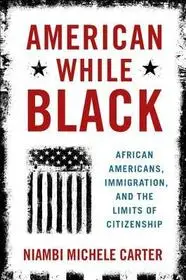
Rövid leírás:
What has an expanded immigration regime meant for how blacks express national attachment? In this book, Niambi Michele Carter argues that immigration, both historically and in the contemporary moment, has served as a reminder of the limited inclusion of African Americans in the body politic. Blacks use immigration as a way to express their concerns about how race operates to structure and constrain their place in the American political landscape. Carter draws on original interview material and empirical data on African American political opinion to offer the first theory of black public opinion toward immigration.
Több
Hosszú leírás:
At the same time that the Civil Rights Movement brought increasing opportunities for blacks, the United States liberalized its immigration policy. While the broadening of the United States’s borders to non-European immigrants fits with a black political agenda of social justice, recent waves of immigration have presented a dilemma for blacks, prompting ambivalent or even negative attitudes toward migrants. What has an expanded immigration regime meant for how blacks express national attachment?
In this book, Niambi Michele Carter argues that immigration, both historically and in the contemporary moment, has served as a reminder of the limited inclusion of African Americans in the body politic. As Carter contends, blacks use the issue of immigration as a way to understand the nature and meaning of their American citizenship-specifically the way that white supremacy structures and constrains not just their place in the American political landscape, but their political opinions as well. White supremacy gaslights black people, and others, into critiquing themselves and each other instead of white supremacy itself. But what may appear to be a conflict between blacks and other minorities is about self-preservation. Carter draws on original interview material and empirical data on African American political opinion to offer the first theory of black public opinion toward immigration.
American while Black provides a starting point for an area of immigration studies rarely examined by scholars: the attitudes of black Americans toward immigrants. Though the book is not exhaustive, it provides a seminal framework for starting policy and political conversations regarding the attitudes and beliefs of black Americans who share a history of slavery, Jim Crow, segregation, and institutional racism. Carter (political science, Howard Univ.) is skillful in approaching the overarching topic of black political behavior through the lens of immigration. Specifically, she discusses black citizenship, identity politics, relationships between minorities in the US, and the implications of a shared black American experience for discourse on immigration.
Több
Tartalomjegyzék:
Acknowledgements
Introduction
Chapter 1: Lies, Fairytales and Fallacies: Immigration and the Complexity of Black Public Opinion
Chapter 2: Citizens First? African Americans as Conflicted Nativists
Chapter 3: Emigrants, Immigrants and Refugees: Immigration as a Strategy for Black Liberation (1815-1862)
Chapter 4: (Re)Remembering Race: Collective Memory and Racial Hierarchy in the Present
Chapter 5: Conflicted Nativism an Empirical View
Conclusion
Appendix A
Appendix B
Notes
Bibliography
Index