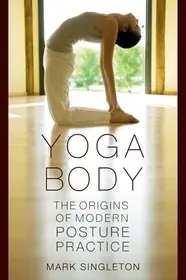
Rövid leírás:
The practice of yoga has become hugely popular in the West. Most people assume (and many claim) that ‘postural’ yoga — characterized by the familiar, demanding, physical poses — is an ancient Indian tradition. But in fact, as Mark Singleton shows, this type of yoga is quite a recent development, with its beginnings traceable to the middle of the 19th-century. Singleton here presents the first in-depth study of the origins of postural yoga, challenging many current notions about its nature and origins.
Több
Hosszú leírás:
Yoga is so prevalent in the modern world–practiced by pop stars, taught in schools, and offered in yoga centers, health clubs, and even shopping malls–that we take its presence, and its meaning, for granted. But how did the current yoga boom happen? And is it really rooted in ancient Indian practices, as many of its adherents claim?
In this groundbreaking book, Mark Singleton calls into question many commonly held beliefs about the nature and origins of postural yoga (?sana) and suggests a radically new way of understanding the meaning of yoga as it is practiced by millions of people across the world today. Singleton shows that, contrary to popular belief, there is no evidence in the Indian tradition for the kind of health and fitness-oriented ?sana practice that dominates the global yoga scene of the twenty-first century. Singleton’s surprising–and surely controversial–thesis is that yoga as it is popularly practiced today owes a greater debt to modern Indian nationalism and, even more surprisingly, to the spiritual aspirations of European bodybuilding and early 20th-century women’s gymnastic movements of Europe and America, than it does to any ancient Indian yoga tradition. This discovery enables Singleton to explain, as no one has done before, how the most prevalent forms of postural yoga, like Ashtanga, Bikram and „Hatha” yoga, came to be the hugely popular phenomena they are today.
Drawing on a wealth of rare documents from archives in India, the UK and the USA, as well as interviews with the few remaining, now very elderly figures in the 1930s Mysore ?sana revival, Yoga Body turns the conventional wisdom about yoga on its head.
What Mark Singleton does prove, with massive, irrefutable, fascinating and often hilarious evidence, is that yoga is a rich, multi-cultural, constantly changing inter-disciplinary construction, far from the pure line that its adherents often claim for it.
Több
Tartalomjegyzék:
List of Illustrations
Introduction
Brief overview of yoga in the Indian traditions
Fakirs, yogins, Europeans
Popular portrayals of the yogin
India and the International Physical Cultural Movement
Modern Indian Physical Culture: Degeneracy and Experimentation
Yoga as Physical Culture 1: Strength and Vigour
Yoga as Physical Culture II: Harmonial Gymnastics
The Medium and the Message: Visual Reproduction and the Asana Revival
T. Krishnamacharya and the Mysore Asana Revival
Bibliography
Index


